
An open-source C++17 engine for backtesting and forward execution, with PineScript support through code generation.









🌐 pineforge.dev · ☁️ Hosted MCP · 🐳 Docker MCP · 📦 Transpiler · 📖 C ABI docs · 🧪 Coverage map · 🔬 Benchmarks
PineForge is a C++17 engine for backtesting and forward execution, with a C ABI for embedding. The engine has two layers:
- A generic kernel — a Pine-agnostic backtest and forward-execution state machine: order matching and fills, sizing, margin and settlement, the bar magnifier, indicator classes,
request.security(), time and session math. It knows nothing about Pine or TradingView. - A source-adapter parity runtime (
src/source/,PineExecutionAdapter+PineStrategyHost) — maps Pine/TradingView execution semantics onto that kernel. This is where TradingView parity lives.
The separate PineForge compiler, pineforge-codegen, translates a PineScript v6 script into a C++ strategy that attaches the engine's Pine execution adapter; it owns translation, not execution semantics. TradingView comparisons measure this Pine path under the tested configurations. The order model describes the current submodels and the remaining migration work; Architecture states the boundary.
- Proven, not promised. All 4,190 probes — 312 open reference strategies plus 413 real community scripts on 15 markets and timeframes — grade excellent or strong against TradingView's own trade lists: 4,182 excellent, 8 strong, zero moderate. The current full sweep evaluates 2,819,967 TradingView trades, with 2,818,237 matched by the verifier.
- Open runtime. The engine and native live runner are Apache-2.0. The separately distributed PineForge compiler uses PolyForm Noncommercial terms with additional personal-trading permission; commercial use requires a separate license. Public reference strategies, benchmarks and validation tooling are available in their respective repositories; the community-script test set is not redistributed.
- Fast. In-process, no interpreter: median 15× faster than PyneCore on 196 timed strategies (a median 603k bars/s per strategy with the bar magnifier on). Parameter sweeps re-run a loaded
.sowith new inputs — no recompile, no fork. - Deterministic to the bit. Two runs with the same inputs produce identical trade lists. Same on Linux and macOS.
- Yours to embed. 97
extern "C"functions across two headers — 65 to run a compiled strategy, 32 to drive the kernel yourself — append-only ABI. Call it from C, Python, Rust, Go, Node, Julia — or let an AI agent drive it over MCP.
claude mcp add pineforge-backtest \
  -- docker run --rm -i -v "$PWD:/work" ghcr.io/pineforge-4pass/pineforge-backtest-mcp:latest
For Claude Desktop, Cursor or any MCP client:
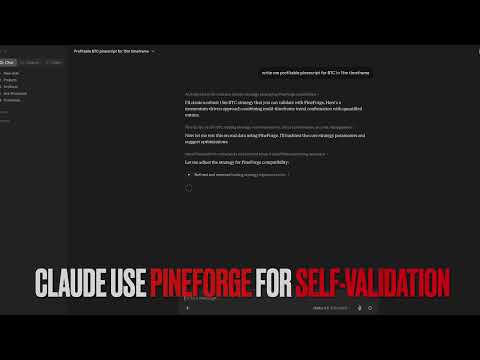
Then ask: "Fetch BTC/USDT 15m for the last 90 days and backtest this strategy" — the container transpiles Pine → C++ with the bundled pineforge-codegen, compiles, runs, and hands the agent the trade list. Nothing leaves your machine. Mount a directory at /work; -i is required and -t must not be added (a TTY corrupts the JSON-RPC stream).
| Ask | Tool |
|---|---|
| "Fetch BTC/USDT 15m data for the last 30 days" | fetch_binance_ohlcv |
| "Backtest this SMA-cross strategy on that data" | backtest_pine |
| "Sweep fast 8–21 × slow 21–55, rank by net PnL" | backtest_pine_grid |
| "What broker overrides are available?" | list_engine_params |
Prefer zero install? The hosted server at mcp.pineforge.dev/mcp (Streamable HTTP, no key) backtests against a sealed Binance spot + USDT-perp data lake, metered per IP. The npm package @pineforge/backtest-mcp mirrors the same server.
git clone https://github.com/pineforge-4pass/pineforge-engine.git && cd pineforge-engine
python3 scripts/ci_verify.py release --build-dir build --jobs 4
bash tutorial/run.sh # MACD on BTC/USDT, end to end
python3 tutorial/run_stream.py # OHLCV warm-up → realtime tradesThe shared local/CI verifier includes source guards, tests and installed-package smoke checks. Its ABI check links callers against both the current library and a separately built, pinned historical library. Preparation uses local Git history and the configured compiler; see the ABI fixture guide for shallow clones and repeated checks. CTest itself stays offline.
Prerequisites: CMake ≥ 3.16, a C++17 compiler (GCC ≥ 9, Clang ≥ 10, Apple Clang ≥ 12), Eigen 3.3+ (fetched automatically if absent), Python 3 for the tests (-DPINEFORGE_BUILD_TESTS=OFF for a library-only build). cmake --install build --prefix /usr/local installs lib/libpineforge.a, include/pineforge/, and the find_package(PineForge) config.
#include <pineforge/pineforge.h>
int main(void) {
pf_strategy_t s = strategy_create(NULL);
pf_bar_t bars[] = { /* OHLCV ... */ };
pf_report_t r = {0};
run_backtest(s, bars, sizeof(bars)/sizeof(*bars), &r);
printf("%d trades, net %.2f\n", r.trades_len, r.net_profit);
report_free(&r);
strategy_free(s);
return 0;
}Every PineForge-compiled strategy .so exports this same ABI — write the harness once, swap strategies forever. Worked examples for C, Python sweeps, Rust, multi-strategy and magnifier A/B are in the docs.
Lifecycle-aware compiled modules reset Pine variables, indicator/history buffers and the broker book before each batch run or strategy_stream_begin warmup. Inputs and runtime settings persist until changed; ticks within a stream continue its state. Regenerate and rebuild existing modules with current codegen and matching engine headers/archive to obtain this behavior; the internal C++ rebuild boundary is checked at compile/link time.
The engine can be driven three ways. All three run the same kernel, so they match trigger, price fills, book lots and settle identically; what differs is who writes the strategy and who owns TradingView's quirks.
Write Pine, transpile it, run the .so. The Pine adapter reproduces
TradingView's execution semantics on top of the kernel; this is the path the
validation scoreboard below measures.
pip install pineforge-codegen
pineforge-codegen strategy.pine -o generated.cpp
c++ -std=c++17 -ffp-contract=off -shared -fPIC generated.cpp -lpineforge -o strategy.so
python3 scripts/run_strategy.py . # or drive it over the C ABISubclass NativeStrategyHost, describe the run once, hand it bars. No Pine,
no codegen, no src/source. The complete file is
examples/native/hello_kernel.cpp —
the strategy half of it:
#include <pineforge/native_host.hpp>
class HelloKernel : public pineforge::NativeStrategyHost {
int bars_ = 0;
void on_native_run_begin() override { bars_ = 0; }
void on_native_bar(const pineforge::Bar&,
const pineforge::NativeDecisionContext&) override {
++bars_;
if (bars_ == 1) {
submit_market({pineforge::order_action::Transact{1.0}, "hello-long", ""});
} else if (bars_ == 3) {
submit_market({pineforge::execution::Flatten{}, "hello-flat", ""});
}
}
};
// configure_native(spec) applies one NativeRunSpec; run(bars, n) drives them;
// trade_count() / get_trade(i) read the closed rows back.The other hosts under examples/native/ cover kernel
sizing and its fee reserve, anchored brackets on a price grid, trails in ticks,
a margin model with a real liquidation and an FX-curve roll, account risk
limits, calculation timing, higher-timeframe series, an auxiliary finer feed,
the open book lot by lot, per-bar broker-state hashes, and a kernel-recorded
report. Each is a CTest row: ctest --test-dir build -R example_.
Hand the runtime a callback table and drive the kernel from any language with
a C FFI — no C++ in your own code. The complete file is
examples/native/hello_kernel_c.c; the
41 strategy_native_* functions are declared in
include/pineforge/native_c_api.h and
summarised in Driving the kernel from C below.
#include <pineforge/pineforge.h>
pf_native_callbacks_v1 cb = {0};
cb.struct_size = (uint32_t)sizeof cb;
cb.version = PF_NATIVE_API_VERSION;
cb.user = &state;
cb.on_bar = on_bar; /* submit / replace / cancel from here */
pf_strategy_t s = strategy_native_host_create_v1(&cb);
strategy_configure_native_ext_v1(s, &spec, &ext);
strategy_native_run_v1(s, bars, n, &report);Coming from PineScript? PineScript to native C++
maps every strategy.* builtin, every strategy() declaration parameter and
every request.* form to its C++ and C spelling, names the example that
exercises each, and walks one six-feature strategy from Pine to a native host
end to end. The native engine guide is the
reference underneath it.
The optional C++17 pineforge-live executable uses this engine's native
warmup-to-stream lifecycle. It accepts normalized ticks or confirmed OHLCV bars,
supports user-defined C++ parsers for broker/provider messages, and commits
inputs plus order-action webhooks to a durable SQLite ledger. Hand-written
C++ strategies use the native contract; generated Pine strategies retain their
compatibility path. Both expose the versioned C ABI used by the runner.
Build with -DPINEFORGE_BUILD_LIVE_RUNNER=ON; the option is off by default,
so core-only users do not acquire SQLite/libcurl/OpenSSL dependencies. See
the native runner guide for feed modes, symbol metadata,
parser ABI, recovery and execution limitations. The existing validation
scoreboard below describes batch backtests; it does not certify new native
live behavior or real broker fills.
Native policy refactoring · 2026-09-10: engine #234 and codegen #127 preserve 4,182 excellent / 8 strong. Both the old-engine/new-codegen and new-engine/new-codegen Cloud runs retain all 4,190 raw trade CSVs, counts and full grades unchanged. The target bands have zero entrants and zero leavers: net 0, no individual regression. These changes remove an unused source flag and give Pine cap behavior explicit ownership; they do not claim complete engine independence. The formal gates remain zero-improvement FAILs and the official baseline remains unchanged.
Round 39 · 2026-09-09: 4,182 excellent / 8 strong / zero moderate across all 4,190 scored probes. This round adds one excellent result, with zero regressions on any canonical metric.
| Board | Test set | Result | TradingView trades evaluated |
|---|---|---|---|
| Public — open corpus | 312 reference strategies, Apache-2.0, reproducible by anyone | 309/309 graded excellent (ETH/USDT-perp 15m; the corpus' declared engine-only / anomaly probes are not graded) | 429,866 |
| Closed test — the parity campaign | 413 community-shared TradingView scripts across 15 market/timeframe lanes: 3,881 script-lane probes — private under TradingView's Terms of Service | 3,873 excellent + 8 strong + zero moderate = 3,881/3,881 (100%) excellent-or-strong | 2,390,101 |
2,819,967 TradingView trades evaluated, 2,818,237 matched by the verifier (99.94%), from the round 39 full Cloud Run sweep. 18 TradingView-side anomalies remain excluded under the unchanged population; each was documented before exclusion. No scored probe remains below strong.
Round 39 extends the existing price-scale admission check to ordinary, fee-free fractional market entries when one minimum lot is worth at least one account unit. It shares the existing financial and order-book scope with the signal-cost check. A separately queued close still fills when the opening is declined, and entries placed after a close retain their established exception.
PK Willow Pulse UT Williams Live Movement on BINANCE:BTCUSDT 15m moves from strong to excellent: canonical match rises from 96.9% to 100%, with zero trade-count gap and zero entry-price, exit-price, PnL and quantity error at the 90th percentile. Independent comparison of the unfiltered files matches all 12,408 physical trade pairs on side, entry/exit times, prices and quantity, gaining 10,756 matches with none lost. Including the displayed PnL in the exact comparison gains 2,193 matches with none lost; the files use different PnL display precision.
The fix has no strategy, symbol or date lookup. TradingView controls pin both directions, flat entries, reversal/close ordering and funding boundaries. A Cloud diagnostic reproduces the original selected trade CSV across all six observed invocations and confirms that the engine passed signal-cost admission but skipped the price-scale check for a high-value fractional lot. The exact explicit-quantity reversal control exposed a separate gap that remains unchanged by this default-sizing fix. All 704 hard-surface probes retain their canonical grades, quantity metrics and trade CSVs; 4,189 of 4,190 CSVs are unchanged. Verifier code, grading rules, profile-selection code, reference tapes, feeds, input files and scored population are unchanged.
| Market · timeframe | Probes | Excellent | Strong | Moderate |
|---|---|---|---|---|
| BINANCE:ETHUSDT.P · 15m (hard lane: zero regression allowed) | 395 | 394 | 1 | — |
| BINANCE:BTCUSDT · 15m | 354 | 354 | — | — |
| BINANCE:BTCUSDT · 1D | 259 | 259 | — | — |
| CME_MINI:ES1! · 15m | 174 | 173 | 1 | — |
| CME_MINI:ES1! · 1D | 117 | 117 | — | — |
| CME_MINI:NQ1! · 15m | 174 | 174 | — | — |
| CME_MINI:NQ1! · 1D | 116 | 116 | — | — |
| NASDAQ:AAPL · 15m | 356 | 354 | 2 | — |
| NSE:NIFTY · 15m | 191 | 191 | — | — |
| NSE:NIFTY · 1D | 145 | 145 | — | — |
| NYSE:F · 15m | 340 | 338 | 2 | — |
| NYSE:F · 1D | 263 | 263 | — | — |
| OANDA:EURUSD · 15m | 373 | 372 | 1 | — |
| OANDA:XAUUSD · 15m | 376 | 375 | 1 | — |
| OANDA:XAUUSD · 1D | 248 | 248 | — | — |
| Total | 3,881 | 3,873 | 8 | 0 |
Every script is exported from TradingView as-is (its own inputs, its own defaults) with the chart's trade list at full precision, transpiled with pineforge-codegen, and run by this engine on the same OHLCV bars. The two trade lists are aligned trade-for-trade and graded by scripts/verify_corpus.py:
- excellent — the same number of trades, ≥ 99% of TradingView's trades matched, entry and exit prices within 0.01% and PnL within 1% at the 90th percentile (trailing-stop scripts are graded on the production profile: exits within 0.05%, since a trail fill depends on TradingView's sub-bar path);
- strong — ≥ 95% matched, trade count within 6%, entries within 0.1% and exits within 0.5% at p90;
- moderate / weak — ≥ 75% coverage, or less.
Published parity results use a fixed population and reproducible Cloud Run measurements. The formal gate requires no hard-surface regression and strictly positive pooled movement across the target excellent and excellent+strong bands. A documented native-correctness exception permits exactly zero target-band movement with no individual regression, after full comparison, independent review and CI; its actual FAIL remains recorded and baseline promotion is deferred. Negative movement is outside this exception. Baseline promotion requires a recorded PASS and an exact-head merge with green CI.
Every gap was closed by pinning the rule TradingView actually follows — never by loosening the grader. Each rule was isolated with sensor strategies exported from TradingView (capital sweeps, literal replays, per-bar state encoded into order comments) and landed with a replay test on the recorded bars. Among them: the broker carries money at ten significant digits (equity rounding, the whole-order drop band, the one-contract margin call, the raw lot floor on every lot-stepped symbol); a trailing stop restarts from the issuing bar's close when trail_points changes and never folds that bar's extreme; a zero-offset trail rides the raw running best and its arming open fills at the nearest-tick print; a reversal rejected at placement preserves standing exits and a separately queued strategy.close, while the distinct fill-time rejection rules govern stop, limit, and trailing legs; sparse ta.atr/ta.tr read the chart's previous close on every execution; pivot levels snap to the tick grid; early-close sessions complete their higher-timeframe bucket; and account-currency conversion is left out of the comparison entirely, because TradingView's FX series is a moving target no fixed table reproduces.
git submodule update --init corpus
docker pull ghcr.io/pineforge-4pass/pineforge-release:latest # optional: re-derive every generated.cpp
VERIFY=1 scripts/regen_corpus_cpp.sh # proves the shipped C++ is byte-identical
JOBS=8 scripts/run_corpus.sh # build 312 .so, run, grade vs TradingView
python3 scripts/regen_validation_report.py # optional: the corpus reportThe corpus feed is a 1-minute Binance ETH/USDT:USDT tape with the 15-minute bars derived from it (corpus/data/derived/). Every probe folder ships strategy.pine, generated.cpp, tv_trades.csv and engine_trades.csv. The probe once filed as a TradingView anomaly (anomaly-equity-mirror-strategy-equity-01) turned out to be TradingView's ten-significant-digit margin call; the rule is pinned and the probe matches trade-for-trade.
benchmarks/ runs 200 strategies through PineForge, PyneCore, PineTS and vectorbt. Every engine gets the same 53,929-bar Binance ETH/USDT perpetual 15m feed, and each trade list is graded against TradingView's own export (266,451 trades):
- 100 corpus probes (slots 001–100) are drawn by mechanism family from the public corpus. Their fixtures are in the public
benchmarks/assetssubmodule. - 100 closed strategies (slots 101–200) are TradingView-scraped community scripts on
BINANCE:ETHUSDT.P15m. Their artifacts are in the maintainers' evidence store (sha6e938f9a…) and are not public. - PyneSys rejects slot 192's source, so slot 201, from the same stratum, stands in for it in the PyneCore count. PineForge runs all 201 slots.
PyneCore sources are official PyneSys cloud-compiler output, with no hand-ports. PineTS runs indicators only, because its strategy backtester is still on the upstream roadmap. vectorbt runs the 13 hand-written ports that load. bash benchmarks/run_all.sh reproduces the public half with no API keys.
| Group | Engine | Slots | Trades emitted | TV trades | 🟢 excellent | 🟢 strong | 🟡 moderate | 🟠 weak | 🔴 minimal | ⚪ n/a |
|---|---|---|---|---|---|---|---|---|---|---|
| corpus | PineForge | 100 | 139,668 | 139,665 | 100 | 0 | 0 | 0 | 0 | 0 |
| corpus | PyneCore | 100 | 199,063 | 139,665 | 84 | 12 | 0 | 3 | 1 | 0 |
| corpus | vectorbt | 13 | 18,040 | 13,637 | 4 | 6 | 2 | 1 | 0 | — |
| closed | PineForge | 101 | 126,732 | 126,786 | 100 | 1 | 0 | 0 | 0 | 0 |
| closed | PyneCore | 101 | 172,535 | 126,786 | 49 | 30 | 8 | 9 | 1 | 4 |
PineForge. The only non-excellent row is closed slot 181. Every TradingView trade is matched, and PineForge emits one extra trade on the window's opening bars.
PyneCore. It has 64 graded non-excellent rows, and most come from the harness window and from request.security:
- 29 rows fail only on PnL (15) or only on trade count (14). In all of them, entries and exits match TradingView to the tick. PyneCore's broker trades from the feed's first bar, five months before TradingView's range opens. As a result, percent-of-equity sizing compounds P&L that TradingView never had, and a position already open at the range start adds one trade at the window's leading edge. The PyneCore runner has no counterpart of PineForge's TradingView-window order gate.
- 9 multi-timeframe scripts reproduce 0–85.5 % of TradingView's history; one has no aligned trades.
- 3 grid bots drift on FIFO drains, and a
str.matchregex filter grades weak. - The remaining rows fail mixed gates.
Four slots have no PyneCore trade list:
- 1 compile rejection: PyneSys rejects slot 192 (
"Empty document."). - 3 runtime errors: PyneCore raises a
RuntimeErrorin itsrequest.securityengine on slots 140, 166 and 197. It hits the same error intermittently on a fourth slot, 143, which could not be timed.
Speed was measured on a quiet host (benchmarks/results/speed.md). PineForge was re-timed at engine 063e4460. PyneCore, vectorbt and PineTS were not re-measured; their figures come from the same host's earlier 2026-09-22 window, at engine e9ad37dd.
- PineForge: a median of 89 ms per strategy over the feed, in-process with the bar magnifier on (603k bars/s; quartiles 425k–731k).
- PyneCore: a median of 1,475 ms per subprocess (36.6k bars/s). The median per-strategy speedup is 15× across the 196 strategies both engines time (p5 6×, p95 68×).
- vectorbt: a median of 102 ms for its 13 ports; PineForge is 1.3× faster on the same 13.
- PineTS: 486 ms for the canonical 10-indicator script.
- Throughput package (
benchmarks/throughput/): the magnifier-off hot loop runs at a median of 0.64 M bars/s per strategy (N=201, median of five quiet runs).
Not comparable with the 2026-06-11 table (PineForge 100/100, PyneCore 85/100, 162×):
- Tiers: they now come from the canonical
scripts/verify_corpus.py::analyze_strategyrubric. The old table graded a different 100-strategy population withcompare.py's own copy of the rubric, which had drifted from the canonical one and no longer parsed the current tape format. - Speed: the ratio fell because the engine is slower per bar, not because the host changed. The 2026-06-11 engine, rebuilt and timed on the same host in the same window, still runs close to its June timings (5–16 % over them in the quieter pass), while the current engine is 10–18× slower on the probes both populations share (provenance).
Last refresh 2026-09-22 (engine 063e4460, PyneCore 6.10.2, PineTS 0.9.34, vectorbt 0.28.2, Apple M4 Max). Per-strategy table: benchmarks/results/summary.md. Population manifest: benchmarks/results/selection.md. Method, fairness and the reproduction recipe: benchmarks/README.md.
Pine v6 script
│ pineforge-codegen (separate repo): Pine → C++ translation only
▼
GeneratedStrategy ── indicator math + strategy.entry / exit / close calls
│ attach_pine_execution_adapter()
▼
Source-adapter parity runtime src/source/, src/compat/pine/
PineStrategyHost, PineExecutionAdapter: Pine order lifecycle, bracket legs,
fill-price and slippage rules, POOC / calc_on_order_fills, margin revival,
trail and stop semantics
│ generic orders, handles, callbacks
▼
Generic kernel src/engine_*, src/native_*, src/ta_*, magnifier, session_time, …
matching and fills, slippage, fees, opening admission and settlement,
bar magnifier, indicators, time and session math
- codegen owns Pine → C++ translation: the
GeneratedStrategywith its indicator math andstrategy.*calls. It does not own execution, fill, bracket or margin semantics. - The source adapter owns TradingView parity: how Pine orders live, fill, bracket, revive and trail, expressed as ordinary kernel orders.
- The kernel targets Pine-agnosticism. It changes only for a generic capability that carries a recorded ruling — for example per-lot excursion accounting exposed as a kernel capability, or a market-if-touched (fill-through) flag on a limit order. No Pine- or TradingView-specific rule belongs in the kernel; such a rule goes to the source adapter or to codegen. Some TradingView-shaped residue does survive in the kernel archive today; every surviving name is ruled by family in ADR 0001 and held there by
scripts/check_kernel_residuals.py, which reads the built archive and fails on a name the table does not cover.
Every kernel capability is opt-in, so adapter runs stay byte-identical by construction: a bare host asks for what it wants in its NativeRunSpec. It can size orders in the kernel (Sized with a cash or equity-fraction basis, optionally reserving the percentage fee), ask the kernel to record the equity curve and its metrics (NativeReportPolicy::KernelRecorded), declare higher-timeframe request.security()-style series (declare_timeframe_subscriptions, or NativeRunSpec::subscriptions) and a finer auxiliary feed beneath them, declare a per-side margin model with a solved liquidation level, and declare account risk limits. The full map, with the C spelling of each, is in PineScript to native C++.
A NativeRunSpec field the adapter never declares is a recorded decision, not an omission: ADR 0001's ruling table gives every one of them a verdict — native-only (with an example and a test), adapter-policy or adapter-hook — and scripts/check_native_feature_rulings.py fails when the table stops being true. Bare native engines (NativeStrategyHost) run the kernel without the Pine adapter. Pine frontends must attach it explicitly and follow the execution attachment and regeneration contract; cap-only generated constructors do not opt into the full adapter. ADR 0001 states the boundary and its rules for contributors; the native feature-parity design is the inventory and the rulings behind it.
# The shared local/CI verifier. Configure, build, ctest, source guards,
# the ABI matrix, the installed-package smoke check — one command per profile.
python3 scripts/ci_verify.py release --build-dir build-ci-release --jobs 6
python3 scripts/ci_verify.py kernel --build-dir build-ci-kernel --jobs 6
# The fast wiring and source checks, no build:
python3 scripts/ci_preflight.py --output-dir build-ci-preflight
# Or plain CMake, when you only want a library and the tests:
cmake -B build -S . -DCMAKE_BUILD_TYPE=Release
cmake --build build -j && ctest --test-dir build --output-on-failureOptions worth knowing (all default off unless noted):
| Option | Effect |
|---|---|
PINEFORGE_BUILD_TESTS |
The C++ test suite. ON by default. |
PINEFORGE_BUILD_SOURCE_LAYER |
ON by default. OFF builds the kernel alone: libpineforge.a then holds exactly the objects of PineForge::kernel, the Pine headers are not installed, and every Pine-bound target is skipped. |
PINEFORGE_BUILD_EXAMPLES |
The Pine-free native hosts under examples/native/, each with its CTest row. |
PINEFORGE_BUILD_CORPUS_STRATEGIES |
A strategy.so per probe in corpus/, for the parity sweep. |
PINEFORGE_BUILD_LIVE_RUNNER |
The pineforge-live executable (needs SQLite3, libcurl, OpenSSL). |
PINEFORGE_ENABLE_SANITIZERS |
ASan + UBSan. |
PINEFORGE_ENABLE_COVERAGE |
Source coverage instrumentation; see scripts/coverage.sh. |
The gates a pull request passes, one line each:
| Gate | Command | What it refuses |
|---|---|---|
| TradingView parity | ./scripts/check_corpus_parity.sh --subset |
A trade that moved: 30 probes re-run and hashed against scripts/corpus_parity_baseline.txt. The full 312-probe sweep (--subset dropped) runs nightly. |
| CTest row floors | ci_verify.py release / kernel |
A test row that vanished: each profile counts the rows that actually ran against a floor. |
| Kernel residuals | scripts/check_kernel_residuals.py |
A TradingView-shaped name reaching the kernel archive or its installed headers without an ADR 0001 row. |
| Feature rulings | scripts/check_native_feature_rulings.py |
A NativeRunSpec field the adapter does not declare and the ADR does not rule. |
| C surface | scripts/check_c_abi_runtime.py, scripts/check_native_c_api_surface.py |
A PF_API export added without its inventory row; a public host member with no C spelling and no recorded reason. |
| Twin parity | scripts/check_twin_parity.py |
A frozen assertion quietly rewritten instead of a behaviour change being argued. |
| Documentation | scripts/check_doc_anchors.py, scripts/check_doc_lint.py, scripts/check_pine_to_native_coverage.py |
A file:line citation that no longer points at its symbol; a stale epoch, roadmap label or negative claim; a Pine builtin with no row on the migration page. |
New here? CONTRIBUTING.md is the human walkthrough of all of the above; Contributing as an LLM is the same ground written for an agent that has been handed a brief in this repository.
libpineforge.a— the static runtime, in two layers:- generic kernel — order matching and fills, sizing, margin and settlement, the bar magnifier, 66 indicator classes,
request.security(), time and session math; - source-adapter parity runtime —
PineStrategyHostandPineExecutionAdapter(src/source/) plus the Pine policy helpers insrc/compat/pine/, which map Pine/TradingView execution semantics onto the kernel.
- generic kernel — order matching and fills, sizing, margin and settlement, the bar magnifier, 66 indicator classes,
<pineforge/pineforge.h>— the public C ABI, the stability-pinned consumer surface.<pineforge/*.hpp>,<pineforge/source/*.hpp>— internal C++ headers the transpiler emits against (generated code derives frompineforge::source::PineStrategyHost); not part of the stability guarantee.- C++ unit and recorded TradingView replay tests; CI on Linux + macOS × Release + Debug, sanitizers, and a
find_packagesmoke consumer. corpus/— the 312-strategy public validation corpus (submodule).benchmarks/— the three-way comparison harness and the throughput package.scripts/—run_corpus.sh,verify_corpus.py,run_strategy.py(load any.sovia ctypes),regen_corpus_cpp.sh,coverage.sh.
This is the runtime, not the compiler. The PineScript → C++ transpiler is pineforge-codegen (pip install pineforge-codegen), bundled with the runtime in the pineforge-release image that the MCP server builds on. It is a backtest engine, not a chart: plot, label, bgcolor compile and do nothing. It is not a TradingView clone: where TradingView's behaviour is undocumented or platform-specific (the bar magnifier's intrabar path, float ordering) PineForge chooses deterministic rules and documents them; where it converges, it converges exactly.
Full coverage map — every TA class, every order primitive, every request.security() semantic, and what is deliberately not implemented: docs/coverage.md.
TradingView ties some day-boundary logic (intraday order caps, session rollovers) to syminfo.timezone and other calculations to the chart timezone. The validator derives the chart timezone from the input CSV; to force one, set "engine_chart_timezone": "<IANA name>" (or "" for UTC) in the probe's inputs.json.
<pineforge/pineforge.h> is the single canonical consumer header. It declares
exactly 65 public PF_API functions: 57 runtime implementations and eight
per-strategy generated exports. Every compiled strategy .so exports that
public set and no internal C++ symbol (-fvisibility=hidden, PF_API on the
public set, checked in CI by scripts/check_c_abi_runtime.py):
| Symbol | Role |
|---|---|
strategy_create / strategy_free |
Allocate / release a strategy instance |
run_backtest / run_backtest_full |
Run with auto-detected timeframe / with timeframe + magnifier configuration |
report_free |
Free arrays inside a filled pf_report_t |
strategy_closed_trade_entry_incarnation |
Per-run physical entry provenance of a closed trade |
strategy_set_input / strategy_set_override |
Override a Pine input.*() value / a strategy(...) declaration parameter |
strategy_set_magnifier_volume_weighted |
Toggle the volume-weighted magnifier |
strategy_set_trace_enabled |
Toggle per-bar trace recording |
strategy_set_trade_start_time |
Suppress historical order placement before a time |
strategy_stream_begin / _push_tick / _push_ticks / _advance_time / _end / _fill_report |
Warm on OHLCV, then run realtime on ordered trades |
strategy_stream_api_version / _push_bar / _order_actions_len / _order_action_get / _order_actions_clear / _state_hash |
Native live extension v1: confirmed input bars, physical fill events and observable replay state |
strategy_set_chart_timezone / strategy_set_syminfo_timezone / strategy_set_syminfo_session |
Chart and exchange time |
strategy_set_syminfo_mintick / _pointvalue / _metadata / _type / _string |
Symbol tick size, point value, numeric metadata, instrument class, string members |
strategy_set_native_security_feed / strategy_set_aux_security_feed |
Feed request.security() from a native higher-timeframe series / an auxiliary bar-aligned feed |
strategy_set_account_currency_fx_series |
Effective-time quote-to-account FX |
strategy_get_last_error |
The latest runtime error |
pf_version_get / pf_version_string / pf_abi_version |
Runtime version, version string, struct-layout version (PF_ABI_VERSION == 4) |
strategy_execution_contract / strategy_configure_native_v1 / strategy_configure_native_fx_curve_v1 |
Query Legacy vs NativeMarketV1; apply the versioned native run specification; stage or clear an immutable native FX curve |
strategy_request_abort / strategy_last_run_status |
Cooperative abort of a run in progress; 0=completed, 1=aborted |
strategy_set_realtime_tail |
Live-runtime surface (ABI v4): the array's last bar is a still-forming tail — barstate.islast=false, last_bar_index/last_bar_time frozen at the horizon bar, no range-end row |
strategy_set_probe_suppress_tail_logic |
ABI v4: the last bar runs only the broker's pre-on_bar steps (pending-order settlement, intraday-cap/loss checks) and returns — no on_bar, no margin-call / POOC second pass / bracket-reissue processing (the range-end row is strategy_set_realtime_tail's to skip; the flags are independent) |
strategy_set_path_order / strategy_last_bar_dual_entry_path |
ABI v4: force the intrabar O→H/L→C leg order (AUTO/HIGH_FIRST/LOW_FIRST) for path-dependent fill probing; read which side won a same-bar dual-entry-stop arbitration |
strategy_set_broker_state_hash_recording / strategy_broker_state_hash |
ABI v4: toggle a 64-bit broker-state hash appended per script bar to pf_report_t::broker_state_hash; read the final state's hash |
strategy_pending_orders_len / strategy_pending_order_get / strategy_pending_order_layout |
ABI v4: the resting pending-order book after the most recent run — count, a POD snapshot per order (pf_pending_order_v1_t), and the snapshot's self-describing field layout |
strategy_pending_order_fill_qty / _level_resolved / _effective_levels / strategy_trail_best_price |
ABI v4: engine-computed values for a resting order — the quantity it would open if filled at a given price, whether its relative offsets resolve yet, its resolved stop/limit/trail-activation levels, and the live position's trail extreme |
strategy_position_avg_price / strategy_position_cycle_seq / strategy_position_size |
ABI v4: the live position's volume-weighted average entry price, its cycle id, and its script-facing signed size |
strategy_closed_trade_entry_id / _exit_id / _exit_comment / _close_cause |
ABI v4: per-closed-trade id/comment strings and a close_cause enum (SCRIPT/BRACKET/MARGIN_CALL/INTRADAY_LOSS_CAP/INTRADAY_FILL_CAP/RANGE_END), indexed like strategy_closed_trade_entry_incarnation |
strategy_current_equity / strategy_script_bars_processed |
ABI v4: initial_capital + netprofit (not Pine's strategy.equity, which also adds open profit); total script bars dispatched by the most recent run |
<pineforge/native_c_api.h> (included by pineforge.h) adds 41 further
PF_API functions for the other direction: a host that is not written in
C++ hands the runtime a callback table and drives the kernel itself — submit,
replace, cancel, execute, read the book — instead of loading a compiled
strategy. They are additive; no symbol, struct or behaviour above changes, and
scripts/check_c_abi_runtime.py pins them as a second, disjoint inventory.
| Symbol | Role |
|---|---|
strategy_native_host_create_v1 / strategy_native_host_free |
Allocate / release a host backed by a pf_native_callbacks_v1 table |
strategy_native_run_v1 / strategy_native_report_free_v1 |
Run a batch of bars into a pf_report_t; release its arrays (the runtime's own report_free, which is otherwise a per-strategy export) |
strategy_native_submit_v1 / _replace_v1 / _replace_ext_v1 / _cancel_v1 / _cancel_all_v1 / _cancel_where_v1 |
The order commands, legal inside a callback or between realtime inputs; cancel_where withdraws every live request carrying one comment or one label. _replace_ext_v1 is _replace_v1 plus submit's own reject out-parameter, so a rejected replace names its RequestRejectReason |
strategy_native_execute_current_v1 |
Execute one live request at the current execution point |
strategy_native_position_v1 / _working_len_v1 / _working_get_v1 |
The physical position, and a copy-out snapshot of the live working book (pf_native_working_v1: its appended trail_has_arm_price tells a trail with no arm price from one armed at 0.0, and a caller sending PF_NATIVE_WORKING_V1_BASE_SIZE is filled exactly that far) |
strategy_native_open_lot_count_v1 / _open_lot_get_v1 |
The physical book lot by lot (pf_native_open_lot_v1: identity, entry facts, signed units, entry fee, fee-net P&L and excursions at a mark) — strategy.opentrades.* for a C host |
strategy_native_events_v1 / _state_v1 |
Poll the recorded event history by ordinal; read the lifecycle and its typed failure |
strategy_native_partial_bar_v1 / _series_bar_v1 / _trail_state_v1 / _liquidation_price_v1 |
The four optional reads — the bar so far at the cursor, a declared higher-timeframe series' latest bucket, a live trail's projection, the solved liquidation level. Each answers PF_NATIVE_ABSENT where the C++ std::optional is empty |
strategy_native_risk_state_v1 / _marked_equity_v1 / _recalculations_v1 / _continuation_hash_v1 |
The generic risk ledger, marked equity at a mark, the driven/suppressed recalculation counters, and the run's continuation identity |
strategy_native_margin_call_v1 |
One margin call's whole economics by its event ordinal (pf_native_margin_call_v1: mark, units, the position before and after, the surviving book's equity and requirement, the re-solved liquidation price) |
strategy_native_sized_units_v1 |
The units a PF_NATIVE_INTENT_SIZED request resolves to under the run's spec — the kernel's own sizing function, as a pure query before submitting |
strategy_native_cohort_open_v1 / _add_v1 / _remove_v1 |
Cohort rosters: a cohort close is PF_NATIVE_INTENT_HOST_SIZED owned by PF_NATIVE_OWNER_BIND_COHORT, sized by the on_close_units hook |
strategy_native_declare_subscriptions_v1 / _ext_v1 |
Declare the run's higher-timeframe series from inside on_run_begin, replacing the staged list; _ext_v1 adds a series source per row and writes the kernel's typed refusal (pf_native_spec_error_e and its field) |
strategy_native_declare_auxiliary_feed_v1 |
Declare, replace or withdraw the run's auxiliary finer feed from inside on_run_begin, with the same typed refusal |
strategy_configure_native_ext_v1 |
Configure from pf_native_run_spec_v1 plus pf_native_run_spec_ext_v1 (report policy, price grid, calculation timing, open-bar view, margin model, higher-timeframe subscriptions, generic risk limits, the auxiliary finer feed, the retained intrabar path, and the slot-label / feed-tolerance / path-order / abort-reporting policies). The two specs' nine enum-valued words stay uint32_t and each has a C enumeration: pf_native_fee_kind_e, pf_native_close_execution_e, pf_native_open_directions_e, pf_native_report_policy_e, pf_native_price_grid_e, pf_native_grid_rounding_e, pf_native_calc_trigger_e, pf_native_open_bar_view_e, pf_native_liquidation_sizing_e |
strategy_native_append_auxiliary_bars_v1 / _ext_v1 |
Append a realtime stream's later bars to the run's declared auxiliary finer feed; _ext_v1 writes the typed append refusal (pf_native_append_error_e) and the bar it stopped on |
strategy_native_declare_opened_lot_entry_bar_mask_v1 |
From inside on_applied, say where the fill that opened a lot sat on its entry bar (pf_native_opened_lot_fill_point_e: on the bar's path, or after it); the kernel derives the lot's entry-bar mask that on_lot_excursion's facts carry back |
strategy_native_api_version |
This surface's layout version (PF_NATIVE_API_VERSION) |
The header's COVERAGE block lists every public member of
NativeStrategyHost with either its C spelling or the reason it has none, and
scripts/check_native_c_api_surface.py proves that list is exactly that
class's public surface — a member added without a row, a row naming a member
that no longer exists, or a spelling naming a symbol the C headers do not
declare all fail CI.
Every struct is tagged and size-prefixed (struct_size, version); an unknown
size, version or enumerator is refused with a documented negative status and
mutates nothing. pf_native_run_spec_ext_v1 has four published lengths — the
layout the lane first shipped (PF_NATIVE_RUN_SPEC_EXT_V1_BASE_SIZE), the same
struct with L9's appended risk tail (PF_NATIVE_RUN_SPEC_EXT_V1_RISK_SIZE), that
plus N8's intrabar / policy tail (PF_NATIVE_RUN_SPEC_EXT_V1_POLICY_SIZE) and the
current one with the auxiliary-feed tail behind it; pf_native_callbacks_v1
has three — the layout the lane first shipped (PF_NATIVE_CALLBACKS_V1_BASE_SIZE),
that plus its six-hook tail (PF_NATIVE_CALLBACKS_V1_HOOKS_SIZE) and the
current one with the policy-hook tail behind it. The runtime accepts each, so a host
compiled against an earlier one keeps working unchanged. An observation
callback that returns non-zero latches
NativeFailureCode::CallbackException and ends the run Failed; the
answering hooks in the table's two tails instead return a pf_native_answer_e
choosing whose answer the kernel uses, and can never fail the run. Streaming
needs no new symbol: the strategy_stream_* family takes these handles
unchanged. Worked example: examples/native/hello_kernel_c.c;
reference: docs/pages/native-engine.md.
POD types pf_bar_t, pf_trade_tick_t, pf_trade_t, pf_report_t, pf_security_diag_t, pf_trace_entry_t, pf_version_t, pf_trade_stats_t, pf_equity_stats_t, pf_metrics_t, pf_equity_point_t, pf_pending_order_v1_t, pf_field_desc_t and the pf_magnifier_distribution_t enum complete the surface. ABI v2 added computed trading metrics and a per-bar equity curve; ABI v3 added pf_trade_t::open_at_end, TradingView's range-end close of a position still open after the last bar; ABI v4 added the live-runtime accessors above plus pf_report_t::broker_state_hash / broker_state_hash_len (a per-script-bar broker-state hash array, appended after equity_curve_len, NULL/0-length unless strategy_set_broker_state_hash_recording is on) and the pf_pending_order_v1_t generated POD mirror of the engine's resting-order record. Check pf_abi_version() before running: the report struct is caller-allocated.
Full flag semantics, string lifetimes and the three L0 evidence lanes behind the ABI v4 live surface: docs/pages/live-surface.md.
Stability guarantee. Within a major version, struct layouts and extern "C" signatures are append-only — fields and functions are added, never reordered, removed or retyped; static_asserts in src/c_abi.cpp pin the layouts. Semantic versioning at the ABI level: PATCH never touches the ABI, MINOR appends, MAJOR breaks. A .so built against 0.X.Y keeps working on any later 0.X.Z.
include/pineforge/ public C ABI (pineforge.h) + internal C++ headers
├── source/ Pine source-adapter headers (pine_adapter.hpp, pine_strategy_host.hpp, …)
└── compat/pine/ Pine policy helper headers
src/ 48 .cpp files in two layers
│ generic kernel (Pine-agnostic)
├── c_abi.cpp C ABI implementations + layout asserts
├── engine_*.cpp BacktestEngine: run loop, orders, execution, path resolution,
│ lower-TF emulation, security + aux security, stream, consumer,
│ metrics, report, trade accessors, state hash
├── native_*.cpp native orders, run spec, calendar, FX curve, execution consumer
├── market_admission / market_driver / pending_order_mirror / reservation_expansion
├── ta_*.cpp 66 indicator classes (moving averages, oscillators,
│ volatility/trend, extremes/volume, misc)
├── magnifier / matrix / session_time / timeframe / timezone / math / str_utils
│ source-adapter parity runtime (Pine / TradingView semantics)
├── source/
│ ├── pine_strategy_host.cpp PineStrategyHost: the base every GeneratedStrategy derives from
│ ├── pine_adapter.cpp PineExecutionAdapter: Pine order lifecycle, brackets, fills, margin
│ ├── pine_strategy_commands.cpp strategy.entry / order / exit / close / cancel lowering
│ ├── pine_scheduler.cpp, pine_scheduler_native.cpp
│ └── pine_aux_security.cpp, pine_state_hash.cpp
└── compat/pine/ exit_activation, exit_lifecycle, market_admission,
order_birth, order_priority, reservation_expansion
tests/ C++ unit, TradingView replay and pure-C ABI tests
examples/native/ Pine-free native hosts, C++ and C, each a CTest row
corpus/ public submodule: 312 strategies + the 1-minute feed and derived 15m bars
benchmarks/ three-way comparison harness, throughput package, results/
scripts/ ci_verify.py, ci_preflight.py, check_corpus_parity.sh, run_corpus.sh,
verify_corpus.py, run_strategy.py, and the check_*.py source guards
tutorial/ MACD end-to-end + streaming walkthrough
docs/ coverage map, Pine v6 audit, Doxygen site (cdocs.pineforge.dev)
├── pages/ the narrative pages, incl. pine-to-native.md
├── design/ the native feature-parity inventory and rulings
└── adr/ 0001, the kernel/adapter boundary
cmake/ PineForgeConfig.cmake.in + the find_package smoke consumer
Documentation: C ABI reference · Getting started · MACD tutorial · Streaming · Metrics reference · FFI from Python · Rust · CMake integration · ABI stability · Coverage. The site rebuilds on every push to main.
- Unreleased (branch
live/abi-v4) — ABI v4 live surface forpineforge-live: 24 new default-off exports (cooperative abort, realtime tail, probe-suppress tail logic, forced path order, a per-bar broker-state hash, the pending-order book as a generated POD mirror, closed-trade id/comment/close-cause, position and equity accessors). No flag changes a historical run:scripts/live_flags_off_identity.py(312 corpus probes, 0 differ vs the pre-v4 branch point),scripts/live_flags_lane.py(312 probes, 0 positives, 130 open-at-end trades subtracted), andscripts/bar_identity_lane.py(row 1: 222,295 bars compared, 2 explained open divergences, 0 else) all pass. 56 symbols. - v0.13.0 (2026-09-05) — the parity campaign, rounds 1–11: TradingView's broker rules pinned with sensor exports and landed with replay tests — ten-significant-digit money, trailing-stop restarts, zero-offset trails, declined-reversal bracket legs, the surviving
strategy.close, sparseta.atr/ta.tr, pivot tick snap, same-bar entry/close transactions, early-close higher-timeframe buckets, 64-bit epoch arrays. Closed test 3,880/3,881; corpus 309/309. ABI v3, 32 symbols, 198 tests. - v0.7 – v0.12 (June–August 2026) — native and auxiliary
request.security()feeds, ABI v2 metrics + equity curve, streaming mode, range-end accounting. See GitHub releases. - v0.6.0 — performance sprint: cached static inputs, thread-local timestamp caching, lazy timezone caching; up to 6.7M bars/s.
- v0.5.0 — Pine v6 compatibility sprint (symbol mappings, constant namespaces, timestamp overloads, collection sorting, bare TA property reads); corpus 234 probes.
- v0.4.1 — clean-room 228-probe corpus, submodule made public, five engine fixes.
- v0.1 – v0.3 — initial release with the pinned C ABI; same-id stop/replace resolution, RMA seed,
-ffp-contract=off; magnifier gap fills and directional mintick rounding.
Read CONTRIBUTING.md (includes the Apache-2.0 contribution grant), or
Contributing as an LLM if you are an agent working from a brief.
The short version: TradingView parity for new work goes in the adapter or in codegen, never in the
kernel; every change keeps the parity corpus byte-identical; anything exported from
<pineforge/pineforge.h> or <pineforge/native_c_api.h> is append-only within a major version.
Bug reports with a Pine script, an OHLCV slice and TradingView's trade list are the most valuable
thing you can send — that is exactly how every rule above was found.
Apache License 2.0 — LICENSE. Third-party notices: NOTICE. Licensing notes (optional AGPL benchmark deps, trademarks): LEGAL.md. Code of conduct · Security policy.
{
  "mcpServers": {
    "pineforge-backtest": {
      "command": "docker",
      "args": ["run", "--rm", "-i", "-v", "${workspaceFolder}:/work",
               "ghcr.io/pineforge-4pass/pineforge-backtest-mcp:latest"]
    }
  }
}